
Committee Organization and How a Bill Becomes Law
Committee Organization and How a Bill Becomes Law
Committee Organization and Responsibilities
Both the House and Senate have standing committees. They are permanent committees that live on from one Congress until the next, unless they are abolished by members of Congress. While the number of committees may change in both houses of Congress, currently there are 17 standing committees in the Senate and 20 standing committees in the House.
Each committee is chaired by a member of the majority party and has a ranking member (member of the minority party). In the 117th Congress, all chairs of committees are Democrats and all ranking members are Republicans. “Committee on Committees” (one for each party) in each house will choose who will sit on the committees. In the House , the Speaker can select all the chairs, but most often he selects those most senior on the committees to head them up. A rule (2005) in the Senate , permits the Senate Majority Leader to fill one-half (1/2) of all vacancies on major committees. Committee Organization and How a Bill Becomes Law.
Can more than one committee have jurisdiction over the same bill? Yes. It is possible for two or more committees to have authority to review different aspects of a bill, like a healthcare bill.
Standing committees can consider proposed legislation – – committee members will debate and vote on a bill. Each standing committee has jurisdiction or power to consider only certain kinds of bills. For example, the House and Senate Judiciary Committees would be able to consider immigration reform and anti-terrorism legislation. However, they could not review farm legislation that comes under the authority of the House and Senate Agriculture Committees.
Wait a minute! Aren’t there other types of committees?
Yes, of course! There are Select Committees that generally only conduct special investigations and report back to the House or Senate. For example, there is the Senate Select Committee on Ethics (investigates the unethical behavior of Senators).
The House Select Committee on Homeland Security (established in 2004) does in fact consider legislation relating to protecting the homeland and the members of the House have recently made this a standing committee.
There is also a Select Committee on Intelligence in both the House and Senate that approves funding for our intelligence agencies.
In addition, there are Joint Committees in the Congress as well. Joint Committees are made up of members of Congress from both houses and they generally are considered “study committees.” For example, the Joint Committee on the Library focuses on the needs of the Library of Congress.
There is one type of committee that you must remember – – Conference Committees. Conference Committees are temporary committees that are established by the House and Senate to work out compromises on legislation . If the House and Senate pass different versions of a bill (e.g., Emergency Supplemental Appropriations bill where House bill requires mandatory withdrawal of troops from Iraq by September 1, 2008 and Senate bill provides for nonmandatory withdrawal of troops from Iraq beginning 120 days after enactment of the bill and withdrawal of most troops by March 2008), a Conference Committee made up of party leaders of both the House and Senate, authors (sponsors) of the bills, chairman and ranking members (vice chairs) of the committees with authority to review appropriations bills will meet to draft compromise language. This compromise is placed in a Conference Report and must be approved by both houses (no amendments/changes can be offered to Conference Reports) before going to the President for his signature. If one house of Congress fails to accept the Conference Report, the bill dies!
LETS HANDLE YOUR CLASS WORK NOW
HUMAN-WRITTEN AND PLAGIARISM-FREE
Committees carry out the following functions:
- Lawmaking – – authorize (create and approve funding) new federal programs (e.g., prescription drugs for senior citizens who receive Medicare), annually reauthorize (re-approve) most current federal programs (e.g., funding for national parks), and authorize/reauthorize funding for all the federal agencies (e.g., Department of Defense or CIA). Most of the committees in the Congress are also authorizing committees, but there is one Appropriation Committee in the House and Senate that firmly establishes through legislation the funding levels for all federal programs and agencies. You may have heard that Congress has the “power of the purse.” It does so because it can provide funding for federal programs and agencies.
- Oversight – – authorizing committees must oversee the operation of all federal agencies and the programs they are asked by the Congress to carry out and enforce. This will be addressed later in the Chapter on the federal bureaucracy.
- Investigative – – Congress has the power to investigate when the federal agencies or officials fail to carry out their responsibilities (Congress investigated the lack of finding weapons of mass destruction (WMD) in Iraq after President was told by the intelligence community that there were WMD in Iraq). Also, when agencies are carrying out the law and something goes terribly wrong – – explosion of the Challenger and Columbia – – Congress can investigate to see what happened and enact legislation to ensure it does not happen again!

How a Bill Becomes a Law
Kathy and Jenny will enter into a colloquy about the Legislative Process:

Jenny, don’t you remember how long it took to fully understand how a bill becomes law?

Yes. It seems so easy to understand now after working on Capitol Hill, but I do remember how frustrating it could be trying to appreciate all its complexities. You thought you understood the process, and then you learned some new procedure!
I was trying to remember some of the questions we asked our legislative director. One of them was: do bills have to be introduced into both the House and Senate to get consideration?
No. A bill can be introduced into one house of Congress and be debated in subcommittee, then full committee, and on the House or Senate floor. Once the House, for example, passes a welfare reform bill, then the bill can be sent to the Senate for its consideration. If there are any changes (amendments) are made to the welfare bill, then the bill is sent back to the House for approval of those amendments. If they are not accepted by the House, the bill is dead and must be reintroduced the next Congress. Committee Organization and How a Bill Becomes Law
But, can legislation be considered in both houses of Congress at the same time?
Of course! Both the House and Senate can be working on the same bill or an entirely different version of the bill. Let’s say, that the House and Senate pass different versions of the bill; the bill cannot go to the President for his signature because the House and Senate the bills do not contain identical language.
A Conference Committee, a temporary committee , is created to work out a compromise between the House and Senate bills. Sponsors (authors) of the two bills, Republican and Democratic Party leaders, committee chairs and ranking members are usually named to sit on the Conference Committee. They are called “conferees.”
What steps does a bill go through to get enacted by the Congress?
Look at the CHART on the LEGISLATIVE PROCESS below.
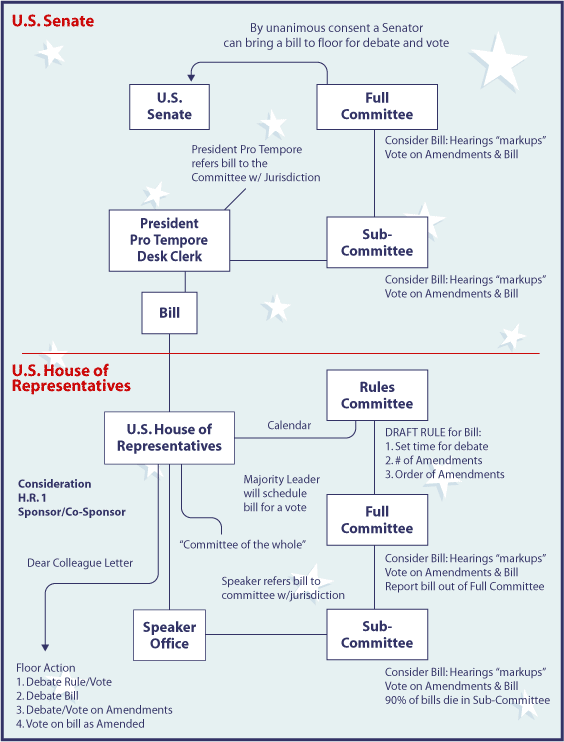
Legislative Process
This image shows a diagram of a the legislative process.
The top half is labeled as U.S. Senate. It moves downward beginning with the statement “By unanimous consent a Senator can bring a bill to floor for debate and vote. Under that is Full Committee – Consider Bill: Hearings have “markups” Vote on Amendments & Bill. An arrow goes left to U.S. Senate. Another line moves downward to Sub Committee Consider Bill: Hearings “markups” Vote on Amendments and Bill. A line to the left connects it to President Pro Tempore Desk Clerk with an upwards right line to President Pro Tempore refers bill to the Committee w/Jurisdiction. A line from the box also goes down to Bill.
A line then separates this section from one labeled as U.S. House of Representatives. A line connects Bill from the Senate portion to U.S. House of Representatives. A line moves right from this box with the word Calendar to a box labeled Rules Committee. Under that box it reads DRAFT RULE for Bill: 1. Set time for debate 1. # of Amendments 3. Order of Amendments and on its opposite side Majority leader will schedule a bill for a vote. . The line continues to a box labeled Full Committee with a line and the words Consider Bill: hearings and “markups,” Vote on Amendments & Bill, Report Bill out of Full Committee and on its opposite side Speaker refers bill to committee w/jurisdiction. The line continues to a box labeled Sub-Committee with the text Consider Bill: Hearings “markups,” Vote on Amendments & Bill, 90% of bills die in Sub-Committee. From the prior mentioned box U.S. House of Representatives another line points to “committee of the whole” and another to a box called Speaker Office which is connected to Sub-Committee as mentioned earlier. A final line from the U.S. House box has to the side Consideration H.R. 1 Sponsor/Co-Sponsor, Dear Colleague Letter, and finally ending at Floor Action 1. Debate Rule/Vote, 2. Debate Bill, 3. Debate/Vote on Amendments, 4. Vote on bill as amended.
When you looked at the Chart above, did you notice the bills must first be considered by a Subcommittee first? Why do subcommittees consider a bill first?
Yes. After I got the hang of looking at the chart!
Once a bill, for example, a welfare bill, is introduced into the House, the bill is printed and sent to the Speaker’s office. The Speaker then refers the bill to the committee that has jurisdiction or authority to review the bill. Once the bill is forwarded in this case, to the chair of the Committee on Ways and Means, he will send the bill to the Subcommittee on Human Resources that has authority, in this case, to consider welfare legislation first .
Does the subcommittee have to hold hearings on the bill or give it any consideration at all?
Yes. After I got the hang of looking at your chart!
Absolutely not! If the Chair of the subcommittee doesn’t want the bill to be reviewed by the subcommittee, he need not hold hearings exploring the nature and impact of the bill. The members of the subcommittee may “kill” the bill by not providing majority support for it during a markup of the bill. In a markup session, the bill is debated and amendments or changes to the bill are offered and voted upon.
Take a look at the Committee on Ways and Means chart below.
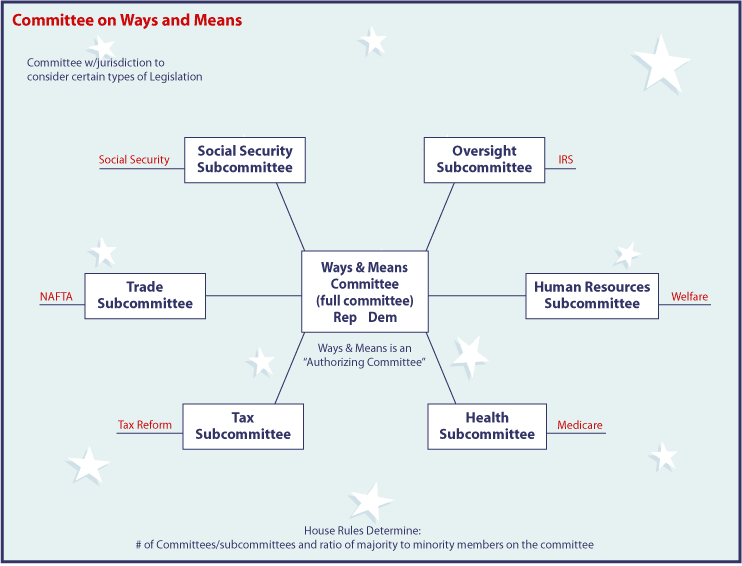
This image shows a diagram of the Committee on Ways and Means, with that term in the middle. The description of this image is Committee w/jurisdiction to consider certain types of Legislation.
The center box is labeled Ways & Means Committee (full committee) Rep Dem. This is an authorizing committee. From this central piece are six connected boxes labeled and described as follows:
- Social Security Subcommittee: Social Security
- Trade Subcommittee: NAFTA
- Tax Subcommittee: Tax Reform
- Health Subcommittee: Medicare
- Human Resources Subcommittee: Welfare
- Oversight Subcommittee: IRS
The image ends with the statement, “House Rules Determine # of Committees/subcommittees and ratio of majority to minority members on the committee.”
So, if the Subcommittee on Human Resources passes the bill, is it then sent to the Committee on Ways and Means? Does the Full Committee have to debate and pass a bill?
To answer your first question. Yes. The bill moves to the Full Committee for its consideration. And no, the Full Committee need not hold hearings or debate and vote on the bill. In the case of our example, welfare legislation, the Chair can choose not to hold hearings or have a “Markup” on the bill. This effectively “kills” the bill in the Committee on Ways and Means. The bill would have to be reintroduced in the next Congress. Yes, it is a tedious process.
I noticed that the Committee on Ways and Means only considers certain types of bills; is this always the case in all committees in the House and Senate?
Yes. You wouldn’t be aware of this, but I referenced this in our Week3 Lesson. All committees and their subcommittees are empowered by the rules of the House and Senate to consider only certain types of legislation. For example, the Committee on Agriculture would not decide whether we need to raise the salary of our military personnel. This issue would be addressed by the Committee on Armed Services that has the jurisdiction to consider this matter.
What happens after the Committee passes a bill, does the bill go to the floor of the House?
Only if it gets a rule issued by the Rules Committee in the House. If the bill passes a committee in the Senate, a Senator can ask that it be immediately brought to the floor for consideration (by “Unanimous Consent” I bring up the bill, S. 4, Welfare Reform).
What is the House Rules Committee?
The House Rules Committee is the most powerful committee in the House because it sets the timeframe for debate on a bill and amendments that can be offered to it on the floor of the House. This is the way debate is limited in the House! If the Chair decides not to issue a Rule for consideration for the bill on the floor of the House, the bill dies in Rules Committee. This also happens if the members of the Rules Committee fail to approve a Rule for debate on a bill.
If the Rule is approved, does the bill then go to the House floor?
Yes. And it must first be approved by the House before a bill can be debated by the entire membership. Generally, if the member wants the bill to be debated, he will vote “Yes” on the Rule. If a member is opposed to the bill, he/she will vote “No.” on the Rule. The member may vote “No” on the Rule, if his amendment (s) to the bill was not permitted to be offered on the floor of the House.
Does the Senate have a formal rule setting debate time for a bill?
No. Unlike the House, a bill can be debated on the floor of the Senate for as long as Senators wish to debate it. For practical purposes, the Senator Majority and Minority leaders work out a timeframe for debate – – let us say, let’s debate welfare reform for two weeks, but it is not binding. Committee Organization and How a Bill Becomes Law
If a Senator does not want a bill or Presidential nomination to be voted on, can he prevent a vote?
Through use of a filibuster bill. Senators can “talk a bill to death” – – control the floor until the Majority Leader pulls the bill. To end a debate, a motion for Cloture must be adopted – – a debate ending procedure. Sixty (60) Senators must vote for Cloture. If they do, the bill can be voted upon.
On March 6 and 7, 2013, Senator Rand Paul (R-KY) led a “talking filibuster” – – 12 hour and 52 minute filibuster against the nominee, John Brennan, to head up the Central Intelligence Agency (CIA). Senator Paul wanted more information from the Obama Administration on the September 11, 2012 Benghazi terrorist attack. When Senator Rand got his answer from the President he ended his filibuster of Brennan’s nomination and Brennan was confirmed by the U.S. Senate.
Today, most Senators threaten use of the filibuster to either stop a bill or nomination from being debated or voted on the floor of the U.S. Senate or to force a compromise by both sides of the aisle on a piece of legislation.