
Communication Model example
Communication Model example
The Model of Communication
There are a number of descriptions and explanations of the transactional model, usually, they are drawing a comparison of the transactional model to earlier models, such as the linear model of communication. What everyone agrees on is that the transactional model emphasizes that communication is an ongoing, transactional process where two people are simultaneously sending and receiving messages. This means that we will define each of the elements, such as sender, receiver, and messages. However, by breaking down the model into elements, it is a bit misleading! We must constantly remember that this process is dynamic, unique, and messy! The model makes everything simpler to understand but it cannot fully capture the chaos that exists every time we communicate with someone else.
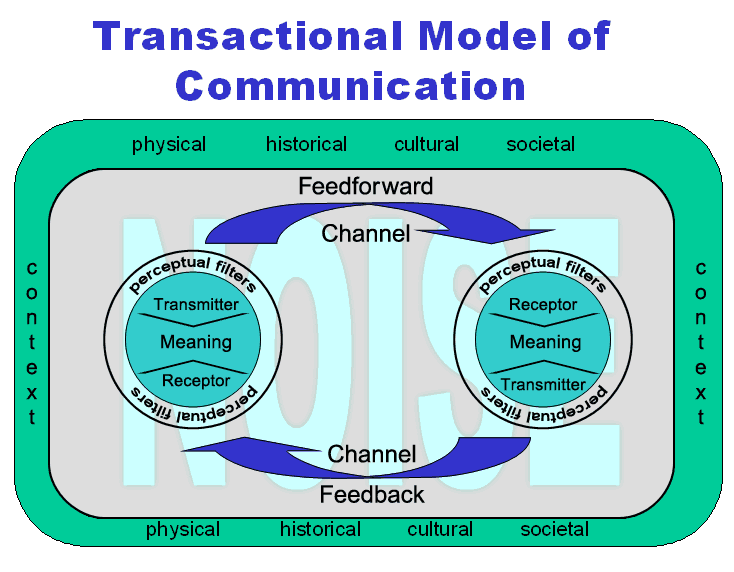
In any face-to-face conversation, the people talking to each other are simultaneously sending and receiving messages. The sender (transmitter) is the person who originates the message and the receiver (receptor) is the listener. However, at any time the receiver (person B) might make a face in response to the sender(person A)’s message. This means that now, person B has sent a nonverbal message to person A, effectively making person B the new sender and person A the new receiver. For the purposes of simplicity, we usually just decide to refer to the two communicators, who are both sending and receiving messages.
The message is the verbal or nonverbal information or behavior that is being sent and received. The message, however, does not contain meaning. It is just a set of words, gestures, images or behaviors. The meaning actually lives in the people who either send or receive messages and each person may perceive the message as having different meanings.
Messages are encoded by the sender, that means that the sender takes their thoughts or feelings and turns them into words, facial expressions, or other types of messages to send the message to the receiver. The original meaning is encoded and turned into a message that can travel through a channel to the receiver. The receiver then decodes the message, translating it into what they think it means. Note that there is plenty of room for error in encoding and decoding a message because meaning is also effected by the context, channel, and noise in the situation Communication Model example.
LET’S HELP WITH YOUR CLASS WORK
HUMAN-WRITTEN AND PLAGIARISM-FREE – ORDER HERE
The message is sent using feedforward, this just means that the original message is sometimes also called feedforward. The real key here is understanding feedback, the response sent by the receiver back to the sender. If you say hi to someone and they smile, they have sent you feedback to acknowledge your message. The smile is the feedback. In the later chapters of the book, we will examine responses much more closely and in greater detail.
Any time we send an encoded message to someone else, we are using a channel, or a vehicle, to send that message. Channels occur in many types and they are often ranked on a scale of richness. A rich channel actually contains many possible channels while a lean channel has relatively few possible channels. When a message is sent face-to-face, you can hear the person’s paralanguage, see their facial expressions, posture and body movements and you can also touch that person, gauge their distance from you and watch many other nonverbal channels. All of that information means that the channel is rich, and you have many ways to evaluate what you think the sender meant when they sent their message. A text message is an excellent example of a very lean message. It consists of verbal characters and emojis. You have stripped out most nonverbal and verbal channels, or ways to get additional information. This makes it much more likely that the message the sender encoded and the one you decoded won’t match up as well.
Channels aren’t the only thing that can influence accuracy in messages, our own minds also play a role. Our perceptual filters consist of our own experiences, thoughts, beliefs, values, and predispositions that influence how we decode messages. For example, people who love cats hear “cat” and think warm and fuzzy, but not everyone shares that perceptual filter. People who hate cats are not thinking good thoughts when they hear “cat.”
As you communicate with someone else, you experience noise or anything that may interfere with the message, on many different levels. Physical noise is anything in the physical environment, like a loud bus driving by behind you as you talk to someone on campus. Psychological noise is noise created in our own minds by our emotions or psychological state. For example, when you feel anxious, you probably have a hard time focusing on your friend’s story about something that happened to them today. Physiological noise is the noise created by our bodies or our physical state at the time. Feeling tired or hungry definitely influences our ability to pay attention and understand someone’s message or to successfully encode our own messages.
Every interaction we have with someone else occurs in a context or an environment, and many elements of that environment shape our messages and their meanings. Some elements of the context are physical, and have to do with your actual location; having a conversation on the street is different from having a conversation in a quiet library. Some elements are historical, the historical context is created by any of our previous interactions with the person. I know that my son is very excited about his new chapter book, The Haunted Library because we have talked about it several times. When he says something about “my chapter book” I know what he means because of our historical context, I can refer to past conversations. The cultural and societal elements of the context in the model involve our culture, or our sets of norms, values, language and symbols, as well as the way that we socially interact according to our cultural beliefs. This means that we encode and decode messages based on the cultural rules we know. If you encode a message based on your American culture, and the receiver is decoding the message based on her Indian culture, you two may arrive at very different understandings of the same message Communication Model example.